
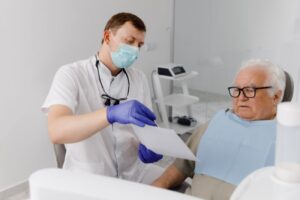
If you are struggling with gum disease, rest assured that treatment can help! Modern periodontal care offers a range of solutions that can eliminate harmful bacteria and restore gum health. One such treatment is known as osseous surgery. In this blog post, we will explain what osseous surgery is and when it may be recommended.
Who Should Get Osseous Surgery?
Your periodontist will carefully assess your gum health to determine the most effective treatment approach. Osseous surgery may be recommended for moderate to severe cases of gum disease that will not respond well to more conservative approaches.
In many cases, however, Osseous is not the first line of treatment. Laser therapy is often a preferred alternative because it is less invasive and is very effective at treating even advanced cases of gum disease.
When is Osseous Surgery Necessary?
Osseous surgery is typically recommended only when gum disease has progressed to the point where non-surgical treatments are unlikely to be effective. Laser therapy is preferred because it is less invasive, and involves faster recovery, however, cannot always address structural changes caused by advanced periodontal disease. In these cases, osseous surgery allows your periodontist to directly treat the underlying bone and create a healthier foundation for long-term gum stability.
What Does Osseous Surgery Involve?
During osseous surgery, a scalpel is used to make an incision, then your periodontist will gently lift the gum tissue to access the areas around the tooth roots where harmful bacteria can hide. The bacteria and plaque are removed and the bone is smoothed and reshaped to make it easier to clean moving forward. Sutures will be used to hold your tissue in place during healing.
Recovering from Osseous Surgery
Osseous surgery can be an important step toward restoring your gum health and protecting your smile. Like any periodontal procedure, it does involve a healing period, but recovery is typically very manageable. Initial healing usually occurs over the first few weeks, while the gums and bone continue to strengthen and stabilize over the following months.
During this time, getting plenty of rest and carefully following your periodontist’s post-treatment instructions is key to a smooth recovery. You may be asked to stick to soft foods for a short period and make temporary adjustments to your oral hygiene routine to support healing.
After you heal, you can look forward to enjoying improved health and a lower risk of future gum disease flare-ups.
Osseous surgery is just one potential tool in the fight to conquer gum disease! Talk to a qualified care provider about your options for achieving a healthier smile.
Meet the Practice
At the Lightfoot Center for Laser Periodontics, we are proud to provide advanced treatments to help our patients find freedom from gum disease. We offer laser therapy, osseous surgery, and a range of other services. To learn more about how we may be able to serve you, contact one of our offices, which are conveniently located in Braintree, Duxbury, Hingham, and Norwood. You may also call us at 781-762-9332. We look forward to serving you!